
Brand voice and reviewer language are different inputs. A Google review tells you what happened and what the customer noticed. Your brand voice tells you how the business should answer: its level of formality, the service names it uses, how direct it is, and what it should never promise.
Keeping those inputs separate is how an AI reply can feel relevant without copying the reviewer’s wording back to them.
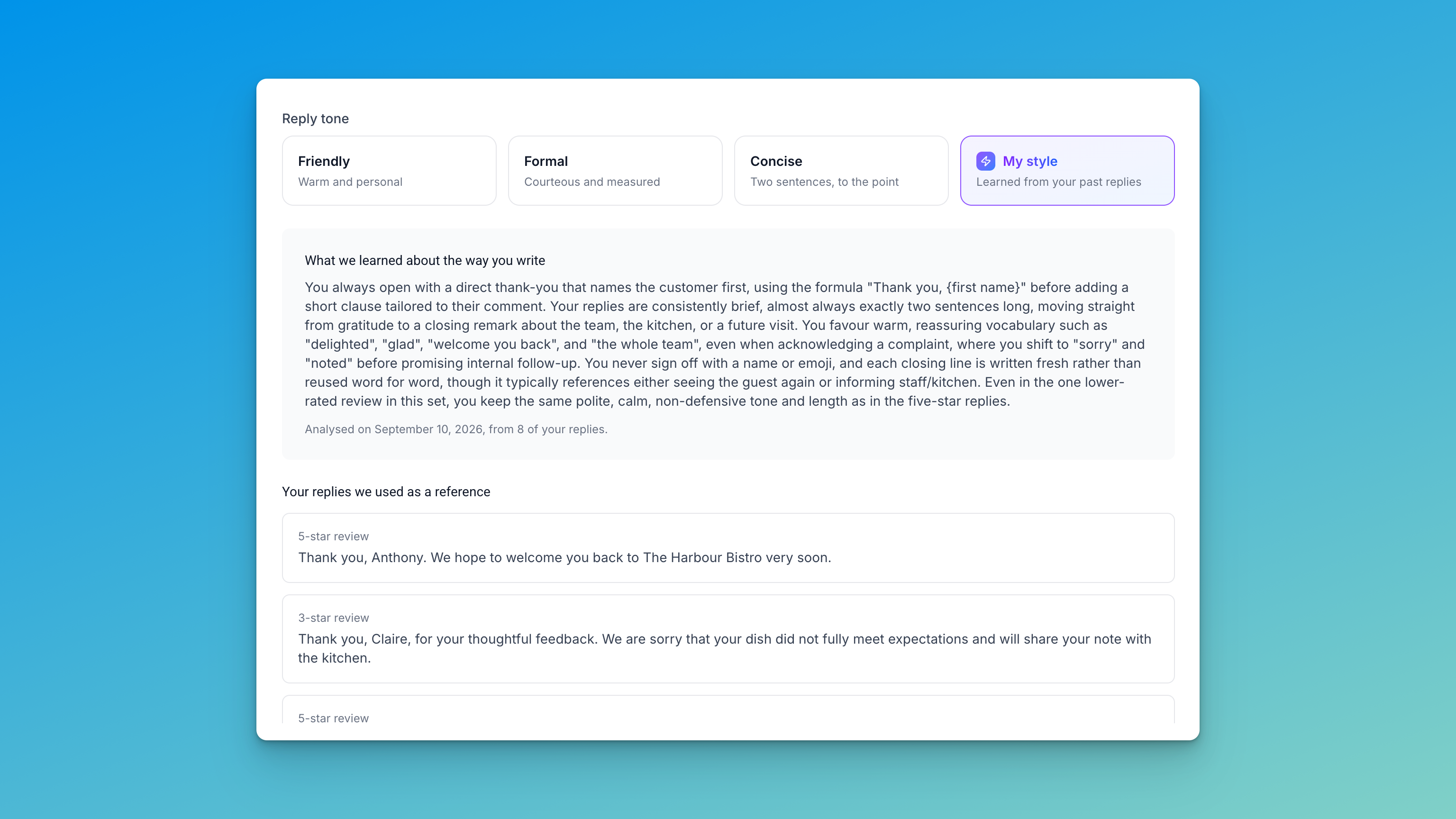
Start with approved business replies
The most useful voice examples are replies that the business has already chosen to publish. Select a small, current set that represents how the owner wants to sound today. They should show choices such as:
- how the business opens and signs off;
- how long a routine reply should be;
- the actual names of services, products, or local places;
- when to invite a customer back or ask them to contact the team;
- phrases the business avoids.
Do not feed every historical reply into the style guidance. Old responses can contain stale offers, awkward language, or a tone the business has outgrown. FullReviews can build a style profile from previous published replies, so the quality of the examples matters more than the quantity.
Treat the review as facts, not copy
The reviewer’s text is useful for identifying the experience to acknowledge. It is not a script to paraphrase line by line. Tell the system to use a specific detail only when it helps the customer recognize that they were heard.
For example, if someone says that “the installation was finished before lunch,” a reply might say “We’re glad the installation went smoothly.” It does not need to repeat every adjective or reproduce the review’s sentence structure. If a reviewer writes a long complaint, the public reply should not restate potentially private or disputed details at all.
This distinction also reduces the robotic pattern where every response opens with “Thank you for your kind words about…” and mirrors the review back word for word.
Write a voice brief that a system can follow
“Friendly and professional” is a starting point, not a usable instruction. A better brief names observable choices:
- Audience: speak to one customer, not a crowd.
- Length: keep ordinary positive replies to one or two short sentences.
- Vocabulary: use the business’s service names; avoid corporate filler.
- Specificity: mention one relevant detail from the review when it is safe and useful.
- Boundaries: do not offer compensation, make legal conclusions, or invent an explanation.
- Sign-off: use the team name, a first name, or no sign-off consistently.
Here is the distinction in practice. Instead of asking AI to “match the customer’s words,” ask it to “thank the reviewer in our concise, down-to-earth tone; mention the service they identified; do not repeat their exact wording; and do not add claims we cannot verify.”
Use an edit loop instead of chasing a perfect prompt
Review the first batch of replies and label the reason for every material edit. Typical labels are “too generic,” “too close to the reviewer’s phrasing,” “wrong service name,” “too promotional,” and “should have waited for approval.”
Then update the examples and rules. If a reply needs fact checking, is about a staff member, or involves health, safety, legal, or aggressive language, do not solve it with a style prompt. Keep it in the human-review lane.
Our brand-voice guide has a fuller checklist, and the approval-rules guide explains when voice guidance should stop and a person should take over.
A safe default
Use AI to draft from the review’s relevant facts and the business’s approved voice. Let a person review exceptions. This produces replies that are recognizably yours without pretending the customer wrote them for you.
To understand where this fits in a connected workflow, read the difference between an AI reply generator and automatic review-reply software.